How to set up oxygen content monitoring and explosion-proof interlock for solvent recovery system? Direct answer: Three layers of defense - online monitoring, continuous monitoring of oxygen content at key locations, with alarm values set according to the concept of lower explosive limit; During the nitrogen replacement, desorption, and parking phases, nitrogen is used to displace oxygen from the system and control the residual oxygen content; Interlock shutdown, automatically cuts off and inerts when pressure or temperature exceeds the limit. In engineering practice, the oxygen content alarm value is often set at a certain proportion of the lower explosive limit, and the common standard is to control the residual oxygen after blowing below 3%. The three layers are independent and serve as backups for each other. If any layer fails, the system should not run naked.
After mixing solvent vapor with air, it will explode when exposed to a fire source within a specific concentration range, and the lower limit of this range is the lower explosive limit. The significance of oxygen content monitoring is to control the oxygen concentration at a safe level, so that the mixture cannot enter the explosion zone. It is more advanced than just measuring the concentration of combustible gases - oxygen is the best controlled one among the three elements of combustion. If you control it, the other two have more room for error tolerance. The monitoring points are selected at the locations where the risks are most concentrated, such as the desorption section and the gas phase space of the storage tank.
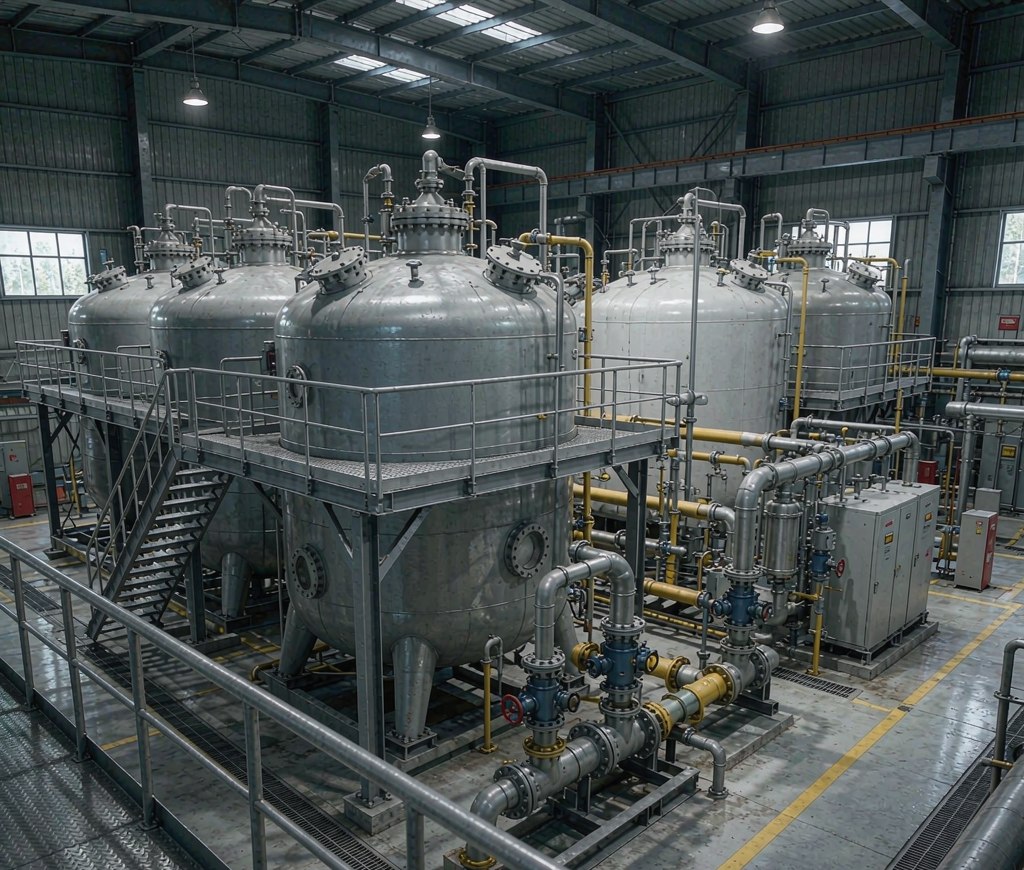
There are two scenarios for substitution. Normal pre desorption replacement: Use nitrogen to blow the bed and pipelines, and exhaust the accumulated oxygen during operation. Only when the residual oxygen content meets the standard can the temperature be increased - if the blowing time is not enough, heat up, which is equivalent to sending raw materials to the explosion zone. Parking replacement: Maintain a slight positive pressure with nitrogen seal before long-term parking to prevent air infiltration; Replace it again before resuming operation. The replacement effect is subject to testing, and there is no one size fits all approach based on fixed duration - the difference in pipeline volume and nitrogen flow rate can result in a significant time difference to meet the standard.
Interlocking is set up in stages: if the parameter deviates, an alarm will be triggered and the load will be reduced. If the deviation persists, the heat source will be cut off. If there are any abnormalities, the shutdown procedure will be followed. The key point is the independence of interlocking - the protection circuit should use independent power supply and independent measuring points, and be physically isolated from the control system to ensure that the protection is still effective in case of control system failure. After the interlocking action, the cause must be identified before resetting. Resetting with a fault is a typical path to turning small hidden dangers into major accidents. Interlocking tests are conducted on a periodic basis, and interlocking that does not move once is equivalent to no interlocking.
| Hierarchy | means | Set reference | Verification method |
|---|---|---|---|
| Monitoring layer | Oxygen content online | Set alarms according to the lower explosive limit ratio | Calibration of standard gas |
| Replacement layer | Nitrogen purging | Residual oxygen below 3% | Portable device review |
| Interlocking layer | Pressure temperature interlock | Cut off the heat source beyond the limit | Real time testing |
| Inert layer | Parking nitrogen seal | Micro positive pressure maintenance | Pressure recording |
| Management | System and Training | Operation ticket with supervision | Exercise inspection |
The actual interlocking test is the watershed of acceptance. A system that only checks the circuit on paper is likely to experience chain failure during the first actual operation - such as solenoid valve jamming, insufficient air source pressure, and signal delay, which are only exposed during actual operation. The test records and interlocking value setting files are archived together, and they are the evidence chain of safety management.
No. First, investigate the cause of the alarm - whether it is due to incomplete replacement, seal infiltration, or instrument drift. If the cause is unknown, do not reset, and operate with a fault is clearly contraindicated.
Calculate based on system volume, target oxygen content, and nitrogen purity, and leave a safety margin; For those with insufficient supply capacity, partition and segment replacement and extend the operation window.
It is not recommended to rely solely on portable devices for systems with dense risk points. The value of online monitoring lies in continuity - gap detection misses the accident window.
This article by LuoyangWohong PetrochemicalEquipment Co., Ltd. arranges that the company provides design, manufacturing and operation and maintenance services for condensation recovery, membrane separation recovery and complete solvent recovery devices for chemical and pharmaceutical enterprises. If you need process evaluation or scheme configuration, please contact and exchange.
Mr. Li 13526990215

Hotline