How to control the noise and vibration of oil and gas recovery equipment? Direct answer: Divide the treatment into two parts based on the source - mechanical vibration relies on vibration reduction and fixation, while aerodynamic noise relies on noise reduction and insulation. Before treatment, distinguish whether it is fan vibration or airflow noise. If the direction is wrong, it will be a waste of money. The judgment criteria depend on the transmission path: low-frequency roaring is transmitted through structural sound, and high-frequency piercing is transmitted through air sound. These two methods are not universal. This article explains the sources of noise and vibration and the grading control measures. Oil and gas recovery devices are often installed in station or factory areas, and when they are close to residential or office areas, noise complaints are a common pain point in operation and maintenance. It is more cost-effective to implement vibration reduction and sound insulation measures in advance than to renovate them after being complained about.
There are generally four types of noise: mechanical vibration caused by unbalanced fan impellers and bearing wear; Unbalanced disturbances caused by the operation of motors and pumps; Aerodynamic noise generated by turbulent airflow and elbow impact in pipelines; Resonance caused by the coincidence of equipment vibration frequency with the natural frequency of the foundation or pipeline. The most easily overlooked aspect on site is solid-state sound transmission - the fan sits directly on a concrete foundation, rigidly connected to the air duct, and the vibration is transmitted through the structure to the floor slab and then radiated into noise. This type of sound transmission is not isolated from the source, and adding more sound insulation later will be twice as effective. First, go through these types of sources before formulating a governance plan.
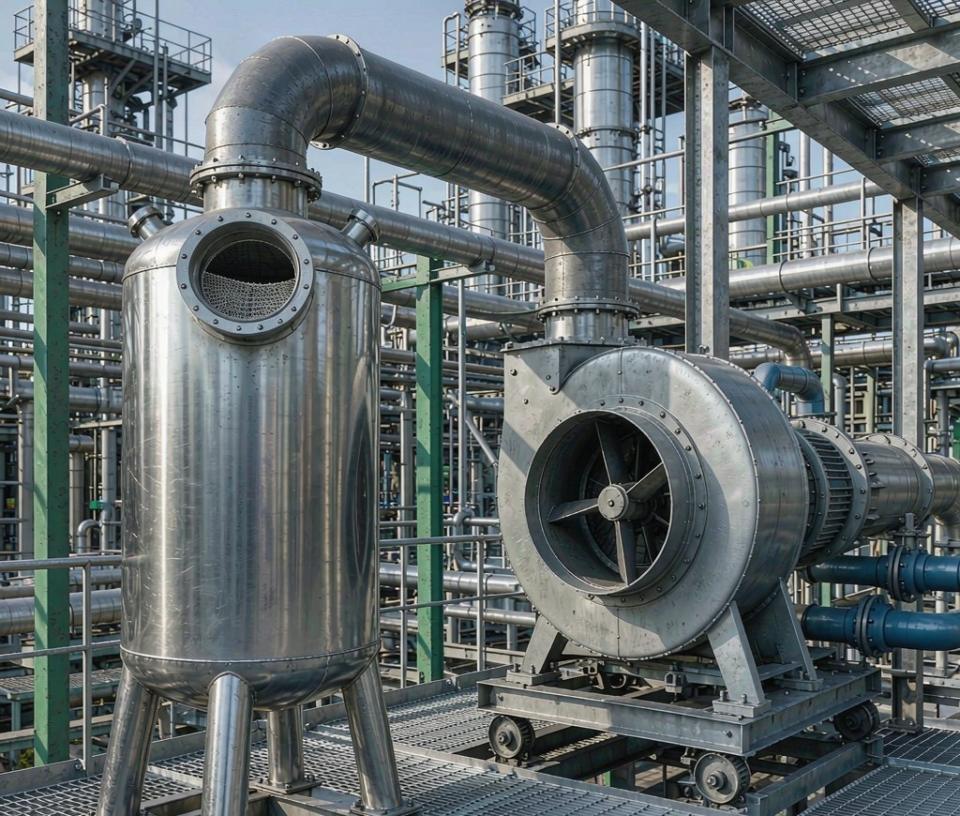
The fan is the primary source of vibration: the base is equipped with rubber damping pads or spring dampers to cut off the path of vibration transmission to the foundation; Add vibration isolation pads between the motor and the base, and use soft connections between the fan and the pipeline to block the solid sound transmission chain. Impeller dynamic balance correction is a long-term method - dust accumulation and wear can cause rotor imbalance. Regularly cleaning the impeller and correcting dynamic balance can reduce vibration and noise synchronously. Bearings should be maintained according to the lubrication cycle, and any wear or abnormal noise should be replaced in a timely manner. Do not wait for excessive vibration. The selection of vibration damping components depends on frequency: rubber pads are used for medium and high frequencies, and spring dampers are used for low frequencies and large amplitudes. Choosing the wrong type of vibration isolation greatly reduces the efficiency.
Pipeline is a vibration amplifier: all rigid connections between air ducts and equipment are replaced with flexible connections, and vibration isolation hangers are added between pipeline supports and foundations to reduce vibration propagation along the pipeline; The diameter of the pipe is designed according to the wind speed, and the elbow is designed with a large curvature radius to reduce diameter changes and tees, thereby reducing airflow impact noise. Equipment foundation reinforcement cannot be saved either: large equipment is equipped with concrete pedestals and damping layers, screws are tightened periodically, and loose supports are high-risk areas for vibration and noise. After rectification, retest: Measure the difference between background and operating noise in affected residential or office areas, confirm that it has been reduced to a reasonable range, and then close.
Air transmission relies on sound insulation and noise reduction: impedance composite mufflers are installed at the inlet and outlet of the fan, covering both medium and high frequency resistance and low frequency resistance; Lay sound-absorbing materials on the walls and ceiling of the computer room to reduce the accumulation of reflected sound; If necessary, install a soundproof cover, but leave access doors and heat dissipation holes to prevent damage to the motor. Both the muffler and the soundproof cover need to reserve space for operation and maintenance, otherwise it will be difficult to disassemble and dismantle during later maintenance and may be easily discarded. The control logic prioritizes front-end vibration reduction and back-end noise reduction, with a reverse order of high investment and low returns.
| source | performance | Control measures | error-prone points |
|---|---|---|---|
| Fan vibration | Low frequency roar | Soft connection of vibration damping pad | Only add sound insulation and continuously vibrate the source |
| Bearing wear | Abnormal noise varies with rotational speed | Lubrication and replacement | Wait until the abnormal noise is obvious before changing |
| Airflow noise | High frequency harshness | Silencer deceleration | The pipe diameter and wind speed are too high |
| Solid state sound transmission | Spread along the structure | Soft connection with vibration isolation | Rigid connection unchanged |
| resonance | Frequency coincidence amplification | Avoid natural frequency | Reinforcement actually exacerbates the situation |
| Motor disturbance force | Unbalanced vibration | Dynamic balance correction | Ignore the imbalance of dust accumulation |
Most of the sound is transmitted through solid materials without interruption: the fan and air duct are still rigidly connected, and the bracket is directly fixed to the floor slab, and the vibration propagates along the structure; The light pad and vibration damping pad are not enough. The soft connection and vibration isolation hanger need to be installed together to cut off the entire sound transmission chain.
Installed in the position directly facing the inlet and outlet of the fan, covering medium and low frequencies; Only installed at the end of the main pipe with the inlet open, the aerodynamic noise still radiates from the inlet, and the overall reduction is limited. Only by treating both ends can it be balanced.
The difference in noise between the two states of operation and shutdown on the affected side should be significantly reduced and lower than the required range of the surrounding environment before it can be considered accurate; Just looking at the readings next to the device does not indicate the impact on the residential area.
This article by LuoyangWohong PetrochemicalEquipment Co., Ltd. arranges that the company provides design, manufacturing and operation and maintenance services for condensation recovery, membrane separation recovery and complete solvent recovery devices for chemical and pharmaceutical enterprises. If you need process evaluation or scheme configuration, please contact and exchange.
Mr. Li 13526990215

Hotline